Data from observations and studies so far suggests that Musopathy offers numerous evidence-based health and wellness solutions.
TBT for Respiratory Health & COVID Rehabilitation
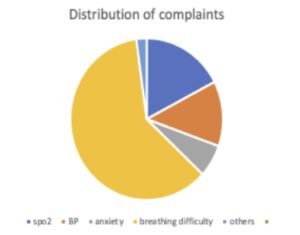 TBT was initiated during COVID and the intervention was administered over Online individual or group Video sessions to over 300 voluntary patients from India and USA. The history of prior complaints were predominantly difficulty of breathing, followed by symptoms of low oxygen saturation.
Among the non-COVID-suffering population (people who had recovered, or never had covid), high BP and high levels of stress and anxiety were the dominant complaints. A few individuals also had complaints of sleep disorders, tinnitus, and essential tremors. A distribution of the history of complaints is illustrated below.
Effect of TBT on Lung Parameters
 Participants were asked to measure their inhalation and exhalation times before and after the TBT session, as a measure of ease of breathing. People with breathing difficulties reported shorter breaths than those without.
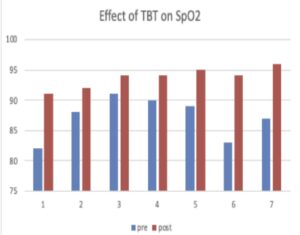
People who had primarily low oxygen saturation measured their SpO2 values using a pulse oximetry before and after the session.
Lung capacity was measured through length of time they could sustain Nasal Tonation (‘mmm’) sound vibration at a frequency of their comfort. Lung capacity improvement was also visible with Spirometer measurements in one or two instances (when it was accessible).
Results
Parameter | Average Improvements | p-value |
SPO2 (points) | 6.5 | 0.00137 |
Ease of Breathing (exhalation time in seconds) | 4.7s | 4.8E-15 |
100% of the participants reported a subjective feeling of improved wellness, ease of breathing and decrease of associated anxiety.
In addition, some individuals also reported improvement in essential tremors, tinnitus, sleep quality and ability to handle stress at work.
The average time taken for first symptoms of noticeable improvement was as little as 15 minutes
Complaint | Time period for first visible results |
Ease of breathing (exhalation time) | 15 minutes |
SPO2 | 15 minutes |
Anxiety | 30 minutes |
Lung capacity (in terms of phonation time) | 15 minutes |
Tremors | 2 months |
Tinnitus | 4 months |
Effect on TBT on Blood Pressure
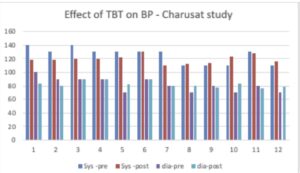 The effect of TBT on Blood Pressure was studied during a clinical trial at Charusat University, Gujarat India. 30 participants (15 male, 15 female) between the ages of 40 and 55 with no co-morbidities were administered TBT 4 times a day for 15 days, with each session lasting 10 minutes.
Blood Pressure was measured in sitting position 3 times a day, and the average of the 3 readings was taken as BP for the day. The daily average BP was considered on day 1 and day 15. Results show a significant difference between the BP values on day 1 and on day 15, according to the Wilcoxon signed rank test.
Effect on TBT on HbA1c: Short Term Pilot Study
HbA1c, or glycated Haemoglobin, is a measure of the average glucose levels over the last 2-3 months. Although HbA1c is conventionally considered a marker of average glycaemic exposure over approximately 8 to 12 weeks, it represents a weighted index, with recent glycaemic levels contributing more substantially to the measured value. Emerging evidence suggests that nearly half of the HbA1c value reflects glucose exposure within the most recent 3 to 4 weeks. Thus, even a 2-week study of a given intervention like TBT is biologically capable of inducing early, detectable shifts in glycation dynamics, particularly through modulation of autonomic balance, stress-related neuroendocrine responses, and short-term glucose variability.
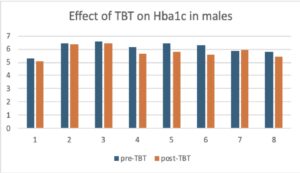
This study was conducted in metabolically healthy individuals who exhibit greater physiological adaptability. Therefore, even modest improvements in glucose regulation observed here may translate into measurable changes in HbA1c. Accordingly, HbA1c in this study is interpreted as an early biochemical indicator of metabolic responsiveness rather than a definitive marker of sustained long-term glycaemic control. These findings support the potential role of the tonation breathing technique as a feasible adjunctive strategy for metabolic regulation, warranting further investigation with 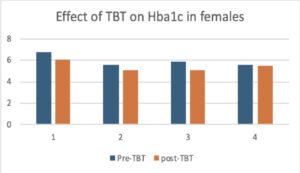 extended intervention durations and follow-up periods.
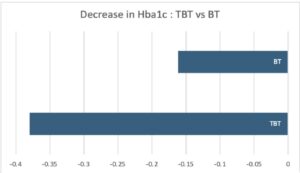
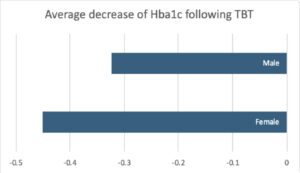
A sex-disaggregated study of men and women was performed, measuring their initial and final levels of HbA1c over 15 days. A second arm was given plain breathing technique treatment, without Tonation. It was seen that TBT significantly decreased HbA1c in both men and women. Breathing techniques without tonation, on the other hand, caused a slight decrease in men. Among women, there was a significant increase in HbA1c.
These preliminary results need to be rigorously verified in larger samples over 3-6 month trials.
Category | Average decrease | p-value |
Male – TBT | 0.32 | 0.0123 |
Female – TBT | 0.45 | 0.0133 |
Effect on TBT on Tinnitus
Two participants with known tinnitus enrolled for a 3 month TBT intervention. A combination of TBT exercises was given to them twice a week. One of the participants also suffered from essential tremor. By the end of 3 weeks, the essential tremors had improved substantially. Both participants reported brief periods of freedom from tinnitus, especially while doing the practice of TBT. Tinnitus being a complex condition, needs perhaps a longer intervention.
Effect of TBT on Mental Agility
Three participants who enrolled in the TBT study 3 times a week reported improved ability to manage stressful situations at work, and improved mental agility.
TBT as an adjuvant in cardiac conditions
One participant who had undergone a surgery for cardiac valve replacement enrolled for the TBT intervention over 3 months. The participant suffered from random and extreme fluctuations of BP. Within 2-3 months of TBT, the participant reported more stable BP, and the consultant cardiologist advised the patient to continue the adjuvant treatment since it was helpful.
Though many of these results are positive, larger follow up studies are imperative before conclusions can be drawn.