Musopathy is a pioneering discipline of medical music for global health and wellness. It brings the universality and rigor of science and mathematics into sound‑centric care, using culture‑neutral research to pursue both measurable and experiential outcomes through applications such as TBT, MANET, and Receptive Clinical Music.
Positioned to complement both allopathic medicine and conventional music therapy, Musopathy addresses one of healthcare’s biggest gaps: thousands of known diseases – over 7,000 of them rare – yet no effective treatment for many of the more than 400 million people affected worldwide.
At its core, Musopathy is an integrative framework for understanding how organized sound, music, rhythm, resonance, vibration, silence, and listening influence human physiology, emotion, cognition, behavior, and consciousness, with potential benefits extending to the cellular level. It connects the dots between science, mathematics, melodic frequencies, rhythmic elements, breathing exercises, meditation, mindfulness, and other evidence‑based practices to create non‑invasive, easily accessible solutions.
Central Role of the Ear
Musopathy leverages on the immense role that the Ear plays in Wellbeing. The ear is the body’s most powerful neurobiological 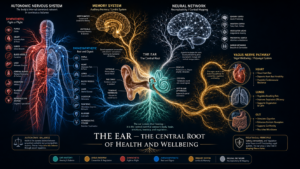 gateway – far beyond hearing and balance.
Through the vagus nerve, it directly regulates the heart, lungs, and gut. Its pathways wire sound into memory and emotion via the hippocampus and amygdala. Every acoustic input reshapes the brain through neuroplasticity, and shifts the body between stress and calm through the autonomic nervous system. Sound, received through the ear, is the root of how we feel, think, remember, and heal.
Traditional cultures (Vedic, African, etc.) recognized the key role of the ear in both cognition and memory, which was why Aural (as opposed to written) traditions dominated the arena of education. The Sanskrit term Shruti (that which is heard) is in fact synonymous with Vedas (knowledge).
Immense Potential
Musopathy sessions do not require musical training, cultural familiarity, or complex devices and instruments, making the approach inherently scalable across ages, cultures, and care settings. With significant academic, therapeutic, social, and commercial potential – and a projected global opportunity exceeding US$ 1 Trillion across converging domains such as sound therapy, physiological, emotional and cognitive health and corporate wellbeing – Musopathy is being investigated in multiple areas, with early findings showing encouraging and clinically relevant trends and potential to enhance overall Quality of Life (QoL) and promote individual and collective Wellbeing by heightening self-awareness, improving focus, attentiveness, self discipline and mind control, boosting innovativeness and decision-making abilities, team spirit and inter-personnel camaraderie, physical endurance, mental resilience, mental agility, productivity and performances, curbing mental fatigue and burnout, enhancing energy levels and promoting both internal and inter-people peace and positivity.
While it draws inspiration from traditional Music Therapy, which has advanced personalized and largely performance‑based palliative solutions using genres such as Western classical, jazz, rock, and Indian classical (Carnatic and Hindustani), Musopathy takes a different, more universal lens. It reframes the conversation around a central question: how does sound function biologically, psychologically, emotionally, socially, and spiritually across human societies, and how might these dimensions support overall wellbeing or even help address certain conditions? To fully appreciate this perspective, it is helpful to briefly trace the origins of music as a therapeutic medium.
Omnipresence of Music
Long before Music became a conscious tool for artistic or devotional expression and communication, it was applied subconsciously by humans only therapeutically, to mitigate emotional and physical pain. Thus one can make a case for Music Therapy (MT) being as old as when we discovered Music. However Melody and Rhythm are as old as Time and as transcendental as Space. In 2023, physicists in Australia, the US, Europe, China, and India almost simultaneously shared papers regarding the ‘Background Hum of The entire Universe that is shaking the stars in a way that can no longer be ascribed to gravitational waves resounding throughout the Universe. Millennia before that, humans observed that there is an inherent rhythm in the periodicity of celestial bodies just as there is in the heartbeats of living organisms.
MT across Timelines
Scholars of modern medicine have observed that music activates more parts of the brain than any other activity, which is what makes it complicated to study. History documents that MT was practiced in several civilizations including India, Egypt, China and Greece. However, the term was not formally used until an article first employed it in a Columbian Magazine in 1789. Over the last century, it has developed into a formal academic area in many universities and documented thousands of important observations. However, as the field of sound-based health matures, it is important to build upon the foundations of MT further and address crucial gaps that have emerged.
Consolidating upon MT’s Gains
Traditional MT largely focuses on providing personalised palliative solutions through performance music like Western Classical, Jazz, Rock, Indian Classical Carnatic and Hindustani, which depend on human capabilities and creativity. Its tendency to study Music itself in a generalised manner, rather than the mechanics behind wellbeing of its embedded components limits its universal application and its potential for standardized, repeatable, and quantifiable clinical research. This translates to a (subconscious) reliance on artistry of performers without accounting for their mindsets at a given time or the mindsets of the recipients of that music.
Massive Unintended Exclusions
It is imperative that the limitless potential of music must not be confused with the limited potency of its practitioners. For instance, an improvisation by an Indian Classical icon or a composition of a Western Classical maestro is likely to provide more relief to those who can relate to it but it is equally likely to not be as effective to those who are unable to connect with it, even within a region. For instance, every European or Chinese may not be equally charmed by Western Classical or Chinese music respectively for therapies centred on these to work, even though research evidence may testify to their capabilities. This means that MT, however unintentionally, excludes the a vast majority of people who are outside the sphere of influence of a given system of music.
Roadmap Ahead
There is a necessity to bring in a complementary system consisting of “Medical Music Formulas” which can help anyone irrespective of their musical affinity, just as an Aspirin tablet benefits even those that may not find resonance with chemistry or biology.
Sound Therapy: Scope and Challenges
The reason behind the current state of affairs is that in most instances, musicians are not top level clinicians and clinicians are not high level musicians. Sound-Health Research scholars can enhance the scope of the field by entering more into collaborations with frontline artists who also have a scientific bent of mind. That will enable other issues given below to be tackled more easily.
Aspects to address in MT
A key reality is that in most instances, musicians are not top level clinicians and clinicians are not high level musicians. Sound-Health Research scholars can enhance the scope of the field by entering more into collaborations with frontline artists who also have a scientific bent of mind. That will enable other issues given below to be tackled more easily.
Paradigm Shift – A Necessity
Since the 1990s, Musopathists have been championing a paradigm shift which can shape the evolution trajectory of MT. In recent times, a few others have also voiced the need for multi-cultural diversity and rigorous documentation of music samples used in MT research and placebo controlled studies involving music from native and non-native cultures.
But what is a real necessity is a shift in the focus from subjective musical experience to quantifiable, parameter-driven inputs in both human and animal studies. Only then, scholars can establish a framework built for precision, repeatability, and global applicability.
Other Sound Therapies
To contextualize Musopathy within the broader landscape of acoustic-based healing, it is essential to distinguish it from other established sound modalities that target specific physical or neurological pathways.
The contemporary sound and music intervention landscape is primarily divided into psychological, physical, and neurological domains. Musopathy carves out a distinct space by moving beyond external dependency and generalized psychological immersion, synthesizing targeted acoustic reception with highly structured, self-generated physiological resonance.
The Broader Landscape of Sound Therapies
Placing Musopathy in Context
Musopathy differentiates itself by formalizing the specific mechanics of internal vibration, resonance, and active neural pathways, thus creating a replicable, medically aligned methodology:
Table: Musopathy vs Other Sound Therapies – Comparative Summary
Discipline | Primary Modality | Mechanism of Action | Main Focus |
Musopathy | Medical Music, TBT, MANET | Internal resonance, targeted physiological & neural engagement | Systematic acoustic and physiological optimization |
Vibroacoustic (VAT) | External Transducers | Mechanical cellular vibration | Physical pain and tension relief |
Neurologic (NMT) | Rhythmic Auditory Stimulation | Neuroplasticity via rhythm | Motor and speech rehabilitation |
Sound Baths | Bowls, Chimes, Gongs | Brainwave entrainment, ambient immersion | Deep relaxation, stress reduction |
To summarise, Musopathy moves away from the subjective, highly variable nature of standard sound therapy and toward a replicable, medically aligned methodology.
Musopathy Approach & Potential
Musopathists aim to conduct research to offer insights into the constituent parts of music common to most systems which forms the crux of the Receptive Musopathy, (and only involves listening to music) as well as on Participative aspects (where they take part in TBT and MANET exercises). Neither of these require knowledge of music or even fondness for it from participants.
There are at least two important pre-requisites for this vision to reach optimal levels:
It stands to reason that most people who may already have a sense of Music appreciation of any genre would find Music Therapy more palliative than those who cannot relate much to Music of any type, where Musopathy could prove to be game changers.
Aspect | Music Therapy | Musopathy |
|---|---|---|
| Core Concept | Use of music by trained therapists to address psychological, emotional, or physical issues | Study and application of sound vibrations’ physiological effects in a culture-neutral, objective manner |
| Target | Relevant populations who can relate to specific genres of music and/or can sing or play themselves | Culture and region neutral global populations including those that have no knowledge of or inclination towards any music |
| Primary Medium | Music (composed songs, instruments, rhythm, melody, harmony) | Avoid the use of music created for entertainment and/or religious purposes. Create specific sound frequencies, tones, and vibrations independent of genre and region as well as Aural Artistic Arithmetics |
| Approach | Subjective, personalized, and often culturally influenced | Objective, universal, and grounded in biophysical principles |
| Practitioner | Certified music therapist with psychological training | Certified Musopathists who have undergone training and/or conducted research and developed a keen understanding of the connect between acoustics, biology, and physiology |
| Application Areas | Mental health, emotional well-being, rehabilitation, education | Psychological as well as certain aspects of physiological health including Respiratory health, cellular activity, microbial influence, plant and animal response |
| Type of Focus | Often qualitative, uses empirical results from therapy sessions | Quantitative, aiming for reproducible, physiology-based results |
| Cultural Dependence | Highly influenced by the patient’s cultural context and preferences | Culture-independent; focuses on natural, universal responses to sound |
| Examples of Techniques | Listening to music, singing, playing instruments, songwriting | Tonation Breathing, controlled vibration exposure, tone-based stimulation |
| Therapeutic Goal | Emotional expression, psychological healing, communication enhancement | Physiological optimization, disease intervention, universal health support |