 Musopathy is a new discipline of Medical Music for global health and wellness. It seeks to take the physio-psycho-neurological and cognitive benefits enjoyed by a small population of musicians to billions, including music-agnostic populations.
Musopathy is designed to act as an integrative framework bridging Modern Medical Science with Music Therapy (MT) and other health options. It pursues quantifiable and qualitative outcomes through originally developed culture-neutral health interventions, connecting the dots between 7 arenas: Mathematics, Science, Melody, Rhythm, Aesthetics, Health and Wellbeing. It seamlessly amalgamates important concepts from Indian Knowledge Systems and other regions, even as it explores the mechanics of musical efficacy on human, animal, plant and cellular wellbeing.
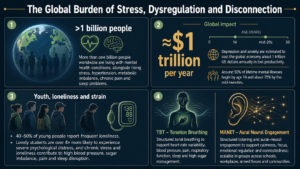
FOCUS: THE MUSOPATHY TRIAD
At the core of Musopathy is a three-part framework, the first two of which involve active participation by subjects:
TBT: Specially created breathing techniques.
MANET: Originally developed rhythmic-math interventions.
Clisonics/Receptive Musopathy: Designed sonic parameters (pitch relationships, timbre, etc) studied for neural, hormonal, and physical effects to create reproducible health interventions. Subjects only listen to the specially created Clinical Sonic Solutions music.
MOTTO: Per Sonum, Scientia Medetur – “Through sound, science heals.”
RATIONALE: It is possible to create a system consisting of “Medical Music Formulas” which can help anyone irrespective of their musical affinity, just as an Aspirin tablet benefits even those who may not find resonance with chemistry or biology.
VISION
To establish Musopathy as a precise, evidence-based, globally accessible science of Medical Music for health and wellness.
MISSION
Advance reproducible research on how core elements of sound affect health.
Develop accessible, low-cost Musopathy interventions for complementary care and wellbeing.
Educate practitioners, researchers, and institutions through structured training and academic programs.
Expand equitable access while supporting safe integration with mainstream medicine.
MUSOPATHY LAWS
Musopathy is anchored on several important principles such as those listed below.
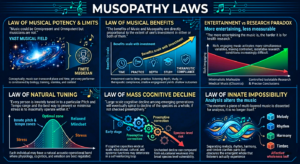
Law of Musical Potency and Human Limitations: “Music could be Omnipresent and Omnipotent but musicians are not.” However, though everyone who has ever touched music since the beginning of human evolution can never match the power of music even collectively, legendary musicians have been able to create music that is good enough to bestow at least some benefits to themselves and to listeners in real life situations, many of which have also been validated by clinical research in recent times.
Law of Musical Benefits: “The benefits of Music and Musopathy are directly proportional to the extent of one’s investment in either or both of them.” This principle applies to almost any beneficial pursuit of life (except financial where macro level market conditions can alter results). Typically musicians tend to enjoy many more benefits from music than listeners.
Law of Entertainment vs Research Paradox: “The more entertaining the music is, the harder it is for health research.” To be aesthetically and intellectually engaging, music has to often be sophisticated but that makes breaking down and studying its various components all the more challenging. This was the trigger for Musopathy Medical Music.
Law of Natural Tuning: “Every person is innately tuned in to a particular Pitch and Tempo range and the best way to prevent or minimise stress is to maximally operate within it.” This pitch and tempo has nothing to do with musical training and can be seen even while a person of normal health talks, walks, jogs or does anything unselfconsciously.
Law of Mass Cognitive & Emotional Decline Trajectory: “Large scale cognitive decline among emerging generations will eventually spiral to intellectual and emotional decline of the species as a whole, if not checked preemptively.” Musopathy can contribute substantially to counter this undesirable trend at the individual and collective level and at least reverse society back to at least normal levels of attentiveness, memories and cognitive abilities.
Law of Innate Impossibility: “The moment a piece of multi-layered music is dissected for analysis, it is no longer itself.” In other words, music is not the sum total of the number of its parts – be it changes in tempo, volume levels, combination of notes, rhythmic configuration etc – but a totality that is much higher, even if there is only one high quality artist improvising for just one minute. The moment every component of a multi-layered sample of music is isolated, it is no longer the original piece of music that is being investigated, making it impossible to assert that “Composition X or Raga Y is the best remedy for hypertension or high blood sugar”.
EVIDENCE & OUTCOMES
Preliminary observations from ongoing Musopathy studies show promising quantitative and qualitative Clinical and Extra-Clinical Benefits including Blood Pressure and Stress Reduction, HRV increases, Higher Mental Calmness, SPO2, Breath Control, Spirometry, Sleep quality, Relief from chest congestion, post-Covid rehabilitation and enhanced Brain Activity, heightened self-awareness, relaxation, focus and Enhanced Quality of Life.
EXCLUSIONS
GENESIS
The word Musopathy is a hybrid term combining “Muso-” (something connected with music) and “-pathy” (from Greek pathos which can mean both “disease,” or “treatment of a disease”.) In this context, it translates to “music-related cure for suffering,” reflecting a system that relies on sound remedies to heal the mind and body (similar to how Naturopathy means “Nature as a cure for suffering”).
Musopathy was proposed in the mid-1990s by Chitravina N Ravikiran who initiated discussions with medical and academic professionals regarding the limitations and pitfalls of choosing music created for entertainment or devotional purposes for therapeutic research in various parts of the world. Though every music-based health experiment across the globe since then can certainly not be attributable to Musopathy concepts, it is pertinent to note that more studies aligned to its essential rationale are being undertaken including research using various single musical frequencies.
POTENTIAL
Given 4 major converging global health markets totalling over US$ 1 Trillion, Musopathy is an exciting area with vast academic, social and commercial potential.
However, the keys for Musopathy impact are is high quality research and enterprise in the next few years. The Indian Institute of Technology (IIT) Mandi has pioneered a full fledged Musopathy MS and PhD program to enable Musopathy research on several fronts. More institutions can emulate this to enable Musopathists across the world to carry out rigorous research in various areas to explore the full potential of this discipline. Organisations collaborating with IIT or Musopathy Foundation are already conducting Certificate Courses and Musopathy Health Camps in various cities.
Allied Research Areas
For those interested in interdisciplinary Musopathy Research and careers, areas that it intersects with include general Medical Science, Neuroscience (especially Alzheimer’s), cellular research, psychology, pain management, motor rehabilitation, TBT-induced dopamine release, Cognitive Improvement/Rehabilitation, General Health Science, Biomedical Science, Music, Yoga, Integrated Medicine, other Therapies and Acoustic Sciences to name a few.
Qualifications of a Musopathist
A Musopathist may be defined as a person who has
Essential Qualities for a Musopathist
In addition to the above qualifications, a Musopathist must also develop qualities essential to benefit those in need. These include: