
Since one of the aims of Musopathy is to create a new genre of Medical Music to seek global health solutions, a prerequisite for every aspiring Musopathist is to have a clear cognizance of the fundamental Universal aspects of music common to almost all systems in the world as opposed to region, culture or genre-based aspects that provide palliative care to relevant populations in Music Therapy.
Receptive Musopathy (where participants only listen to the music) focuses on:
UNIVERSAL ASPECTS
Almost every system in the world that use 12 tones per octave is made up these essential aspects listed below.
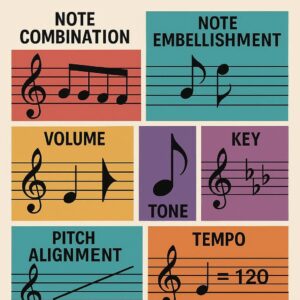
Note Embellishments
The combination of plain and moving notes are almost universal to most systems of music. These movements can be of two types:
(a) Movements applied to the notes themselves like vibrato, tremolo and minute oscillations
(ii) Movements between two notes such as wide oscillations and glides (glissandos), referred to as meend or jaaru in Indian music.
Typically, music of most major genres consist of a mix of plain notes and moving notes. The impact of various types of movements applied to or between notes on human well being has not been isolated and studied thoroughly to date and therefore remains a barely understood concept. There is no doubt that it would be very difficult for most scholars to isolate the two and study the efficacy of each of these components but unless each type of movement applied to notes is studied exclusively and extensively, there will be unbridgeable gaps in our knowledge of Music Therapy as a whole. But given that moving notes translate to move hearts and even transform potentially dissonant passages into pleasing ones or vice versa, it is imperative to carry out multiple research projects in this area soon.
Volume and Dynamics
The volume of sound (loudness or softness) is typically measured in decibels (dB), a logarithmic unit that reflects the intensity of sound waves through a device known as sound level meter or decibel meter. Just like Tempo, sound volume will also impact aural neural systems. Common sense again dictates that soft music can be soothing and loud music can trigger stress (in the short/long term) but only precise studies can ensure the right kind of prescriptions.
Tonalities: Timbre and Texture
(i) Timbre in music (pronounced TAM-bur) is the distinctive sound of any specific musical instrument like a violin, sitar, chitravina, flute or trombone. Even when two different instruments play the same note, the sound of one will be distinguishable from the other. In broad terms, TimbreIn broad terms, Timbre can shrill and bass but in reality, the timbre of various instruments and voices can be as diverse as a colour palette in a sophisticated photo software.
In theory, Timbre can play a subtle or dominant role in human, animal, plant or probably even in microbial level responses but in practice, conclusions from studies involving Timbre can be elusive, since individual preferences can vary. For instance, some may respond positively to the sound of a violin but when the same music is played on a trumpet, the response could be quite the opposite – or vice versa. Therefore, studies involving timbre may be not only challenging but may also end up having only limited relevance – unless they are very extensive, involving large populations.
(ii) Texture in general can be understood as the collective result of many similar acoustic events such as rainstorms, insect swarms, and galloping horses. Music texture are the ways in which different sound layers are combined in a musical piece to create a sense of depth and richness. The texture of a piece of music is influenced by factors such as the number of voices or parts, their relative strengths, and the relationships between them. Textures can be of several types.
Monophonic: Single melodic line, where only one voice or instrument is heard.
Polyphonic: One can simultaneously hear two or more voices or instruments playing melodies complementary to one another.
Multi-Layered: One can hear different musical elements at the same time – melody, rhythm, and perhaps with harmony.
Textures can also be Homophonic (a solo artist performing to harmonic accompaniment by a supporting ensemble, like what one hears in pop and rock music) or Heterophonic (two or more versions of the same melody being played at the same time, but with slight variations in rhythm or pitch).
Studies involving any texture other than monophonic can be even more challenging since multiple voices and instruments will simultaneously be involved (like an orchestral piece of music). These may or may not result in concrete conclusions even when they are very extensive, involving large populations.
Despite this obvious flaw, several Music Therapy studies have used such music for their experiments which has resulted in numerous observations across the world ranging from the inconclusive to the misleading.
Key Change and Octave Change
Since both of these can come under the ‘combination of frequencies’ category, they have not been extensively discussed here. However, future experiments may probably show that these can also be impactors to health and wellbeing.
Pitch Alignment and Beat Effect
Listening to music that is tuneful or not is an immense factor in well-being, though most people intuitively will avoid listening to music that is not aligned perfectly to the pitch. When two sources of identical music are simultaneously performed but are even minutely not aligned to each other, they will definitely result in a disturbing aural-neural reaction. This happens frequently when two or more artists aim to perform in unison OR even when a single artist performs to the accompaniment of a source of tonic note like shruti box or tanpura (seen in Indian Classical Music) but fails to align perfectly with this source. This out of sync or as out of tune music can cause a substantial amount of tangible or intangible, visible or invisible, short or long term stress to both the performer and the listener. However, this area needs to be studied in detail to quantify its negative impact on the health of humans (and probably other species).
Tempo
The pace in which the music is rendered will have a significant impact on aural neural systems. In very broad terms, slow music (if not outrightly boring) can inspire calmness and tranquility and fast music can rejuvenate and energise. That said, very fast music can also result in hypertensive reactions and slow music can be even more depressing to people with such predispositions. Studies need to be carried out to ascertain what can be prescribed in what proportion to people with various conditions.
By accounting for all these, Musopathy scholars will be able to provide not only qualitative but quantifiable evidence that can be assessed by any objective expert in any part of the world irrespective of region or culture.
GENRE SPECIFIC ASPECTS
These are too numerous to be itemized as every genre of music has distinctive elements and aesthetic yardsticks based on its evolution, regional and cultural preferences of its architects as well as listeners and at times its chemistry with other cultures etc. However, a few prominent factors include:
Pitch values of notes and intervals between notes: Most music evolved systems use 7 notes called Sa, Ri, Ga, Ma, Pa, Da, Ni in Indian Music and Doh, Re, Mi, Fa, Sol, La, Ti in Western and by other names in various systems. The 8th note will again be Sa or Doh, which is why the set is called an Octave. Most systems also use 12 tones within an octave because they are discernible to most human ears. There are two distinct ways of producing even the main 12 tones that makes systems distinctive: Just Intonation and Equal Temperament Tuning.
Successive vs Simultaneous Note Combinations: Based on this factor, systems can be Melody-based like Indian Classical or Harmony-based like Western Classical, Jazz etc. It goes without saying that even harmony based systems will have various combinations of simultaneous notes in succession. But the impact of successive or simultaneous combinations is one of the main characteristics that bestow systems with distinctive identities.