Data from preliminary studies (including ongoing ones) affirm the efficacy of Musopathy for a variety of complaints ranging from Covid to Stress Management. Several of the non-invasive studies are covered by IIT Mandi – Institutional Ethics Committee approval IITM/IEC(H)/2023/VD/P2. Here are a few highlights. 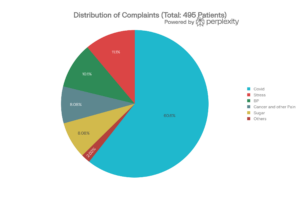
Respiratory Health & COVID Rehabilitation
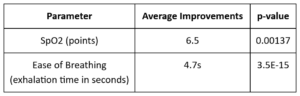
TBT intervention was provided via online sessions to over 300 patients in India and the USA during the COVID-19 pandemic. Primary complaints included difficulty breathing and low oxygen saturation. Among non-COVID-suffering populations, high BP, stress, anxiety, sleep disorders, tinnitus, and essential tremors were dominant. TBT sessions significantly improved ease of breathing and SpO2 levels.
Key Results (TBT for Respiratory Health)
Subjective Outcomes
Aromatase inhibitor-induced musculoskeletal symptoms (Mayo Clinic)
A TBT study initiated by the Mayo Clinic (USA) on cancer patients to reduce aromatase inhibitor-induced musculoskeletal symptoms showed positive results in some participants, but expansion was limited by logistical issues.
Effect of TBT on HbA1c – Short-Term Pilot Study
Prediabetes is a highly prevalent and potentially reversible stage in the progression to type 2 diabetes. Early non-pharmacological interventions that are simple, scalable and low-risk are important for preventing disease onset. Breathing-based interventions have been shown to influence autonomic balance and metabolic regulation, but their impact on glycaemic markers in healthy or at-risk individuals remains underexplored.
A study by Charusat University, interpreting HbA1c as an early indicator of metabolic responsiveness, found that TBT significantly decreased HbA1c in both men and women. Plain breathing techniques without tonation showed a slight decrease in men but a significant increase among women. While several individuals have reported significant (~ 20 mm/dL) drop of blood sugar values even after 5-6 minutes of TBT, large scale long-term trials (3-6 months) are being planned.
Blood Pressure
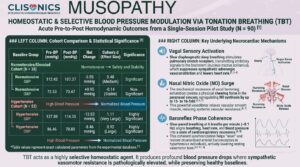 Bhavanagar Medical College: The first session of the TBT study in May 2026 TBT (CTRI Registration: REF/2026/05/131477) demonstrated a large, acute, and clinically significant reduction in BP in 90 adult participants. Average Systolic BP drop was nearly 10 mmHg and Diastolic drop was over 5 mmHg, meeting or exceeding reported reductions from standard slow breathing exercises or music listening alone. Notably, the hypotensive effect was amplified in the subgroup with baseline hypertension, where SBP fell dramatically by 22.1 mmHg, a result consistent with a homeostatic regulatory mechanism. These device-free, quantifiable findings establish TBT as a highly promising, non-pharmacological adjunct for hypertension management, justifying rigorous investigation through randomized controlled trials.
Charusat University: A 15-day clinical trial in 2019 with 40 healthy participants (20 Males and 20 Females aged between 40 and 55). They received TBT four times daily and showed a statistically significant difference between Systolic Blood Pressure values on Day 1 and Day 15 (Wilcoxon signed rank test).
Heart Rate Variability (HRV)
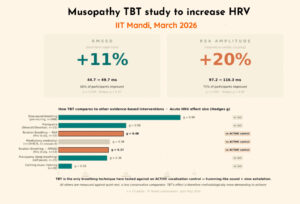 A controlled study of 53 adults conducted with IIT Mandi (April–May 2026) tested Tonation Breathing against an active vocalisation control — a deliberately rigorous comparator that already includes slow exhalation and sustained sound, so that any remaining advantage for TBT must come from the technique itself, not from humming or slow breathing in general. Across two leading measures of vagal (parasympathetic) function, TBT produced immediate, measurable, and clinically meaningful improvements: RMSSD rose by approximately 11% and respiratory sinus arrhythmia by approximately 20%, with 66–75% of participants improving and both effects clearing established medical thresholds for clinical relevance (p = 0.009 and p = 0.001, respectively). Importantly, the control vocalisation on its own offered no measurable advantage over quiet breathing — confirming that the calming, restorative effect is driven by the specific way Tonation Breathing is performed, not by humming or slow breathing alone. The size of this benefit is statistically on par with externally-paced pranayama and 6-breaths-per-minute slow-paced breathing – two of the most rigorously validated breathing techniques in modern physiology – larger than the per-session effects reported for passive calming-music listening, and on stronger statistical footing than single-session mindfulness meditation. Notably, TBT is the only technique in this comparison shown to be effective against an active vocalisation control rather than against quiet rest, establishing a technique-specific benefit beyond what slow breathing or humming alone can deliver. A larger randomised controlled trial is now in development to test these effects over an 8-week training period. [/caption]
Acute Stress Management
In recent Musopathy TBT studies with over 55 participants, single guided sessions led to more than a 30% increase in positive feelings and a more than 30% drop in negative feelings, with 96.2% of participants improving on positive affect and 94.2% reducing negative affect. These changes correspond to very large effect sizes (Cohen’s d ≈ 1.3–1.5 for positive mood and 1.2–1.4 for reduced negative mood), placing TBT at or above the impact levels reported for many music- and breathing-based wellness solutions. Notably, strong gains were seen in high‑stress groups—including a cancer patient, individuals whose negative feelings dropped to zero, people with diabetes reporting calmer moods and short‑term blood sugar reductions, and participants with depression, anxiety, or ADHD who felt more focused and “extremely positive.” Together, these results position Musopathy TBT as a gentle, non‑invasive, differentiated, high‑impact modality with real‑world emotional and physiological benefits for users from adolescence through older age, designed to complement standard medical care.
Mood Management
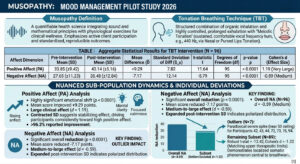 Bhavanagar Medical College: A single 15–20 minute Mood Management session for 96 adults in May 2026 of Musopathy TBT showed its efficacy, validating its position as a scalable digital solution for mood regulation, strongly supporting its potential across cognitive/brain-health, corporate wellness, and sound therapy markets. Highlights:
Positive Affect (PA): Increased by a highly significant +27.6%. The effect size was exceptionally large (Cohen’s $d = 1.17$), surpassing typical single-session mindfulness results.
Other Mood Management studies were conducted in various regions in India and USA for over 120 participants also showed similar results, producing rapid, measurable shifts in experiential state on standardized Likert or PANAS scales. Participants reported moving from moderate to ‘quite a bit’ levels of feeling relaxed, focused, engaged, and cheerful. In parallel, anxiety‑related states such as restlessness, worry, anxiety, and tension showed moderate to large reductions as well.
Pain Management
About 20 adult participants (men and women in their 40s–50s with musculoskeletal pain mainly in the back, ribs, neck, shoulders and hips), participants rated multiple pain qualities and provided 0-10 global pain scores immediately before and after a TBT session. Across nearly all respondents, present pain intensity decreased from a moderate pre‑session level to substantially lower post‑session values, with several reporting very low or no pain after TBT, indicating a consistent immediate analgesic effect rather than isolated responses. Descriptors such as cramping, throbbing, gnawing, aching, and tiring‑exhausting pain showed the greatest prominence at baseline. One participant reported substantial improvement over a period of 8 days without pain medication. Further studies are going on in various centers.
Moyamoya Disease
Moyamoya disease is a progressive cerebrovascular condition and many participants also presented secondary pulmonary hypertension, not to mention low blood oxygen levels, over 65 incidents of apnea per hour (breath stopping and depriving the brain of oxygen and having numerous other negative consequences), not to mention intense anxiety and depression. In a case study involving a 48 year old female, 4-6 weeks of Nasal TBT practice (4 times a day for 6-8 minutes each) proved to be most impactful in managing several of these issues, verified by quantitative and qualitative evidence.
Mental Agility
Several online participants reported improved mental agility and better ability to manage stressful work situations. Ongoing MANET studies in IIT Mandi for Cognitive sharpening are showing promising results too.
Adjuvant in Cardiac Conditions
For one participant with extreme BP fluctuations following cardiac valve replacement surgery, 2–3 months of TBT resulted in more stable BP, leading the consultant cardiologist to advise its continuation as adjuvant treatment.
Tinnitus
In a 3-month TBT intervention for two tinnitus participants, one experienced substantial improvement in essential tremors within three weeks. Both reported brief, practice-specific periods of freedom from tinnitus, suggesting a longer intervention is needed for this complex condition.