A part of the human race has always suffered from Mental Health Disorders and Dementia. The two terms are distinctive as the former refers to psychological disorders that affect mood, thinking, and behavior while Dementia covers a group of symptoms that are more neurological, affecting memory, thinking, and social abilities. It is important to appreciate this distinction as treatment approaches and long-term prognosis for each condition varies. Typically, mental issues are caused by genetic, environmental, and psychological factors and are age-agnostic. They can improve or go down speedily and do not affect long term memory or rob a person’s overall independence. But dementia, primarily caused by physical changes in the brain (such as the buildup of abnormal proteins or damage to brain cells) appears only past the age of 60-65, is usually irreversible, impacts memory so severely that it ends up making the patient completely dependent on others.
Prior to checking out Musopathy interventions for such disorders, it is important to address perhaps the most severe issue in society today – mental pandemic.
The Greatest Emerging Threat: Manufactured Cognitive Decline
The greatest emerging global causes of Cognitive decline even among normal people are Sensory Bombardment due to Device and Social Media Addictions and increasing dependence on AI, spanning across generations.
There is absolutely no doubt that AI is exponentially reshaping the world positively too but the concern here is more about how the majority are using it not only for Lower Order Intelligence operations (like basic information-processing skills like noticing, remembering) but also for Higher Order Intelligence operations (such as analysis, synthesis, creativity, judgment, etc).
While students are the most vulnerable to this mental pandemic, millions of adults including elderly citizens have also fallen into this category. A highly disturbing fact is that Decreased Attention is Trending now, because numerous Social Media platforms are promoting 15 second content, causing cognitive and memory disorders by suggesting shorter content to millions of viewers, who are also losing their sense of discernment to assess whether they are genuine or not, thanks to a plethora of AI generated content. It is a no less bemusing fact that AI is being promoted even to search for a pencil in one’s own room, dumbing down people, faster than the speed of light.
Areas Compromised
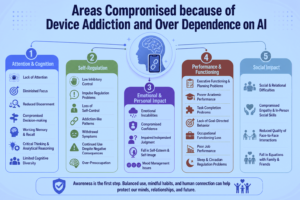
But it is not only attention and focus that have been – and are being – compromised. Very little is spoken about how discernment and decision making abilities are also being alarmingly eroded but yet, these are only the tips of this giant iceberg. Overall, areas compromised because of Device Addiction and Overdependence on AI include the following:
From Cognitive Decline to Civilizational Decline
These patterns are already spiraling to a vicious cycle, infringing upon the physical, emotional and cognitive balance of the individuals. They not only result in underperformance but also sub-optimal levels of thinking and impaired decision-making abilities, not to mention emotional consequences such as stress, anxiety and depression. In organisational settings, this can translate to huge deficits in productivity and profits, leading to the Law explained below, if we are not wakeful enough.
The Musopathy Law of Mass Cognitive & Emotional Decline Trajectory states that “Large scale cognitive dissonance among emerging generations will eventually spiral to intellectual and emotional decline of the human species as a whole, if not checked preemptively.”
It is imperative for educators and families to build cognitive strength as well as mental resilience among emerging generations to arrest these trends. The prerequisites for these are acute awareness and appreciation of the scale of the problem as well as potential solutions like Musopathy.
How Musopathy Protocols can combat this and other illnesses
Musopathy MANET and TBT can contribute substantially to counter several natural as well as self-inflicted illnesses such as Stroke, Parkinsons, TBT and provide Cognitive Rehab Training (CRT) at the individual and collective level.
MANET in particular, brings in an original approach that recognises that the human ear can play a major role in Cognitive Training and Cognitive Enhancement. This can be applied to most populations who have had even a basic Grade 3 level School education. Nasal Tonation and other TBT Techniques have been shown to bring down Blood Pressure. Focused studies will enable scholars to draw more precise conclusions.