In a nutshell, Musopathy Aural Neural Engagement Techniques (MANET) consists of originally developed rhythmic-math interventions to foster Cognitive Improvement and to prevent or manage Cognitive Impairment.
It engages more with the human ear and brain in contrast to many other pattern-recognition and problem solving options that are centred on the eye-brain coordination.
The human brain is among the most amazing creations in the known universe. 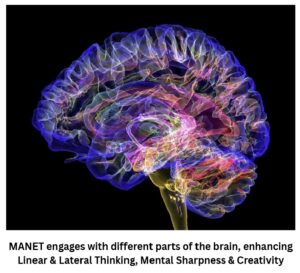 Though it only weighs slightly more than 1kg, it consists of over 100 Billion neurons and controls everything from movement to memory, from breathing to behaviour and from thought to emotions. When it is performing optimally, it is like the conductor of a great symphony orchestra, ensuring that every individual function is both tuneful and harmonious. But when brain functioning is less than optimal, it becomes an impediment that could severely affect the quality of one’s life. The good news however is that the brain can respond to intrinsic and extrinsic stimuli, reorganize and rewire its neural connections, enabling it to adapt and function in ways that differ from its prior state.
While various interventions exist for improving cognitive abilities, MANET, leverages on the two topline evidence based approaches – Music (especially Rhythms) and Mathematics. Neuroscientific research shows musical and rhythm training have a significant positive impact on cognitive development. Similarly, there is substantial evidence vouching for the role Mathematics plays in promoting pattern recognition, mental calculations, counting, sequencing and manipulating numbers, improving reasoning, spatial visualization, stimulating neural pathways, working memory and focus, enhancing strategic thinking and problem-solving abilities and enabling critical thinking and innovativeness. One can easily imagine the health benefits one can potentially get combining elements of both music and math.
Road Readiness of MANET
MANET is not only a theoretical level discourse. Over 300 MANET exercises have already been created so far for therapeutic studies and applications, targeting diverse ages, stages, capabilities and conditions of participants. Hundreds more are being developed.
Striking Data Point
It is most significant that practitioners of Carnatic Indian Classical music who are also engaged with its alluring mathematical aspects are seldom threatened by cognitive decline or dementia even way past their 70s and some of them have shown ideal levels of mental ability and agility even past their 100th year. While inspired by this, MANET has been studiously developed to cater to global populations and neither demands Carnatic training or imparts its artistic aspects to participants.
Common Causes of Cognitive Issues
Cognitive impairment involves declines in thinking, memory or reasoning skills. Common causes include:
But there is one factor that is as severe as all the above, though barely discussed.
Manufactured Cognitive Decline
But one of the greatest emerging global causes of Cognitive decline that is not being discussed adequately is Sensory Bombardment due to Device Addiction, spanning all generations. While students remain the most vulnerable to this threat, millions of adults including elderly citizens have also fallen into this category.
A highly disturbing fact is that Decreased Attention is Trending now, because numerous online platforms are promoting 15 second content, (perhaps unintentionally) causing memory and cognitive disorders across borders by suggesting shorter content to millions of viewers, who are also losing their sense of discernment to assess whether they are genuine or not, thanks to a plethora of AI generated content.
From Cognitive Decline to Civilizational Decline
These patterns are already spiraling to a vicious cycle, infringing upon the physical, emotional and cognitive balance of the individuals. They not only result in underperformance but also sub-optimal levels of thinking and impaired decision-making abilities, not to mention emotional consequences such as stress, anxiety and depression. In organizational settings, this can translate to huge deficits in productivity and profits. At a larger level, what starts off as cognitive decline among individuals will quickly spiral to Social Cognitive Decline and eventually to Cognitive Decline of the human species as a whole, if preemptive steps are not taken across the board immediately.
Necessity of Musopathy
Musopathy MANET and TBTs are necessities today to counter both traditional and emerging causes of cognitive dissonance. It is imperative to speedily combat the undesirable social trends and reverse both individuals and society back to at least normal levels of attentiveness, memories and cognitive abilities. MANET, along with TBT, can accomplish these given its sophisticated but non-invasive approach to engage with several areas of the brain and also address emotional issues. Timely intervention of MANET has the potential to combat or even prevent certain aspects of dementia like memory loss. MANET also is a great mood enhancer that can also combat Stress, Anxiety and Depression. In workspaces, it can be a great tool to build innovative approaches as well as team spirit.
Mechanics of MANET
MANET taps on several important aspects of highly evolved systems such as Carnatic Indian Classical, which is not only aesthetic but also draws significantly on mathematical elements in the realm of both melody and rhythm. But it does not demand knowledge of Music or a greater than elementary school level math from participants.
In simple terms, MANET = Elements of (Music + Mathematics)
Its two main features are:
Both of these work in diverse ways to improve individual and collective wellbeing. MANET sessions can be given to individuals or even large groups of people.
Singular Engagement
MANET engages with several interconnected parts of the brain including the auditory cortex, hippocampus, amygdala, cerebellum, various motor and frontal regions and prefrontal cortex etc as also anterior cingulate cortex (ACC), dorsolateral prefrontal cortex, and other frontal regions that are involved in grasping, memorising and creative innovations. Since rhythmic aspects also involve motor functions, MANET also engages with parts such as Primary Motor Cortex, Premotor Cortex, Supplementary Motor Area and Basal Ganglia. In summation, MANET is a multi-sensory cognitive workout with numerous advantages.
Benefits
MANET fosters both linear and lateral thinking and offers numerous benefits including:
Characteristics
Why is MANET a Necessity for the elderly?
Cognitive Scaffolding (temporary support and guidance provided to a learner by a more knowledgeable individual like a teacher) through interventions MANET has extra relevance for elderly populations because of the following reasons:
MANET, Math & Rhythm
MANET leverages not merely on rhythm in a generalised fashion but several aspects of it, including the concept of structured Cyclic Time Signatures known as Tala, a highly developed concept in Indian music. There are hundreds of Talas but all of them have two main components (especially in South Indian Carnatic music):
From a health standpoint, Talas engage several parts of the brain and promote alertness from a very young age in a singular manner. This in turn enables participants to understand and express simple numbers and patterns in a structured manner. It also increases their sense of time and tempo and builds up positive energy, momentum and confidence, leading to enhanced wellbeing.
MANET exercises chiefly include:
Simple Problem Solving through diverse arithmetic arrangements of Rhythmic Patterns and creating logical Cadenzas
MANET, MELODIC SCALES & MODES
Fundamentally, Scales and Modes are combinations of usually 5 to 7 notes. Most systems are composition centric and note order of a scale or mode can be flexible. However, in sophisticated melody-centric systems like Indian Classical, every addition, deletion or alteration of note-sequence leads to the formation of a different mode (Raga) with a unique identity. For instance consider the following 4 sequences (Indian equivalents of note names like Do – Re – Mi and corresponding notes from the middle C of a Piano are given):
(i) Sa-Ri-Ga-Ma-Pa-Da-Ni-Sa (CDEFGABC)
(ii) Sa-Ri-Ma-Da-Ni-Ga-Pa-Sa (CDFABEGS)
(iii) Sa-Ri-Ma-Pa-Da-Sa (CDFGAC)
(iv) Sa-Pa-Ma-Ga-Ma-Pa-Dha-Ni-Sa (CGFEFGABC)
Though both have identical notes, the re-ordering of notes in (ii), the deletion of notes in (iii) and the zig zag pattern of (iv) make them distinctive from one another. Indian musicologists have calculated that over 7.2 million scales and modes can be formed through such permutation and combination of notes. MANET workouts involve re-organising a given scale in several ways leveraging on these permutations and combinations of notes, which require no real knowledge of music theory but can yet exponentially enhance creativity and improve cognitive functions. However, those with musical inclination can also try them out on keyboards, pianos or other instruments. These neural and emotional engagement exercises can exponentially enhance creativity and improve cognitive functions.
Unlike TBT where even instructional videos may suffice, MANET needs face-to-face interactive sessions (live or online) with experts, at least initially. This will enable participants to receive feedback from instructors to ensure that they approach it in the right manner to optimise their health benefits. Email us to schedule your sessions.