
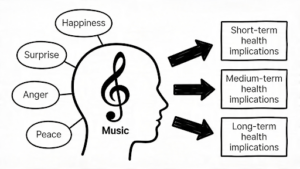
 It is a fundamental fact that music elicits responses like happiness, surprise, anger, sorrow or peace from most listeners which can also have short, medium or long term health implications.
The route to global level Music-Health solutions is designing studies that isolate the essential elements of music irrespective of genre. This is easier said than done because more often than not, studies that are perfectly designed from a clinical standpoint are not so from a musical viewpoint and vice versa. Even when top performers and researchers collaborate, it is easy to overlook the need to study the basic mechanisms behind musical impact because of the intense magnetism that music and composers exert over scholars. This is a major reason for genre specific phenomena such as Indian Ragas or composers like Mozart to be popular choices for studies, though recently, there are more studies aligned with Musopathy approach (even when the term is not used).
Sentiment & Detachment
The route to global level music-health solutions is designing studies that are both clinically and musically impregnable. But the intense magnetism of music and scholars’ immense respect for composers or treatises (whose declarations they try to validate through simplistic designs) make it impossible to develop an emotional detachment and treat music only as a functional research tool. This is a major reason for culture based phenomena like Indian Ragas or composers like Beethoven to be popular research choices. But unsurprisingly, meta analysis fails to reproduce the same results from various studies in such scenarios. However, when studies are intentionally centered on specific populations with homogeneous musical preferences as well as emotional issues, culture specific music can be better research options.
These non-negotiable, quantifiable elements of music, which are independent of any specific cultural style, serve as the Macro Level Music-Science foundation for Musopathy interventions like Clisonics and TBT. It is to be noted that Musopathy currently focuses on systems using 12 discernable tones within an octave (though there are systems which use many more).
Parents of Music: Melody and Rhythm
Melody and Rhythm are the unanimously accepted foundations of music, captured by the Sanskrit phrase “shrutir maata, layaf pitaa” (Melody is Mother, Rhythm is Father). Musopathists need to have a clear cognizance of the essential aspects listed below.
Note Combinations
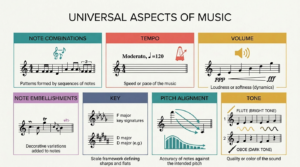
No matter the system of music, the chemistry between the various notes determines not only how pleasant, melancholic or disturbing they could sound to a majority of people but also the kind of health impact they could have. The combination of one note with another when rendered successively can be consonant (friendly), dissonant (unsettled) or assonant (neutral). The 1st and 5th sound universally harmonious whether rendered in succession or simultaneously while the 1st and 4th sound harmonious to people used to Indian music while the 3rds sound nicer to Western ears. But the common feature between all these is that all of these intervals are in precise mathematical ratios. When several notes are combined in a formulaic manner, they result in Scales and Modes.
Note Combinations in Mood Management
It is not far-fetched to postulate that consonant combinations of notes will have a more benevolent health impact for many conditions. Typically, the Scales using notes in the Major Scale (Raga Shankarabharanam/Bilaval) are considered to be bright and cheerful while Minor 2nd, 3rd, 6th, 7th and Sharp 4th (which corresponds to the Carnatic Raga Bhavapriya) are considered to be melancholic. When more notes like Sharp 2nd and 6th and Double Flat 3rd and 7th (which are employed by systems like Carnatic and Western) are brought in, even more complex combinations can be generated, with varying health implications.
Note Embellishments
The combination of plain and moving notes are almost universal to most systems of music. These movements can be of two types:
(a) Movements applied to the notes themselves like vibrato, tremolo and minute oscillations
(ii) Movements between two notes such as wide oscillations and glides (glissandos), referred to as meend or jaaru in Indian music.
The impact of various types of movements on human well being has not been isolated and studied thoroughly to date but unless they are, there will be unbridgeable gaps in our knowledge of Music Therapy as a whole. Given that moving notes translate to move hearts and even transform potentially dissonant passages into pleasing ones or vice versa, it is imperative to carry out multiple research projects in this area soon.
Pitch Alignment and Beat Effect
Performing or listening to music that is perfectly tuneful is an immense factor in well-being. The converse is also equally true. When two sources of identical music are performed but are even minutely not aligned, they cause a disturbing aural-neural reaction. Likewise if artists using a source of the tonic like a drone (shruti box or tanpura) fail to align with it perfectly, the short term and long term stress and related issues can be significant not only to them but also to listeners. This is again an unexplored area in MT research but the sooner it is studied, the easier it will be to put preventive measures in place like training even casual singers or instrumentalists to be more tuneful.
Volume and Dynamics
Volume, or the loudness or softness of sound, is independent of genre but has a significant influence on aural-neural systems. It is measured in decibels (dB), a logarithmic unit. Common sense suggests soft music is soothing and loud music triggers stress, and precise studies are needed for prescriptions. This parameter is crucial for defining the objective boundary of non-benevolent sound. Musopathy establishes the concept of a Hazardous Tonality Dose or Toxic Acoustic Signature by quantifying the point at which universal parameters – Volume, Tempo, Texture and Dissonance – cease to be functional and begin to cause measurable systemic harm.
Key Change and Octave Change
Since both of these can come under the ‘combination of frequencies’ category, they have not been extensively discussed here. However, future experiments may probably show that these can also be impactors to health and wellbeing.
Tempo
The pace in which the music is rendered will have a significant impact on aural neural systems. In very broad terms, slow music (if not outrightly boring) can inspire calmness and tranquility and fast music can rejuvenate and energise. That said, very fast music can also result in hypertensive reactions and slow music can be even more depressing to people with such predispositions. Studies need to be carried out to ascertain what can be prescribed in what proportion to people with various conditions.
By accounting for all these, Musopathy scholars will be able to provide not only qualitative but quantifiable evidence that can be assessed by any objective expert in any part of the world irrespective of region or culture. But it is important to note that though each of these aspects are individually significant, they may not necessarily be sole factors in health outcomes and may have to be studied in conjunction with one another.
The diversity of global musical genres introduces numerous variables, each shaped by distinct cultural, historical, and aesthetic influences. While these subjective factors underpin music’s artistic value, they complicate its use in standardized scientific and clinical research. Therefore, Musopathists must maintain emotional detachment and approach music as a functional tool in research design and application. A few prominent factors include: 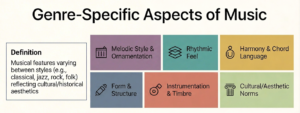
Pitch values of notes and intervals between notes: Most music evolved systems use 7 notes rendered as Sa, Ri, Ga, Ma, Pa, Da, Ni in Indian Music and Do, Re, Mi, Fa, Sol, La, Ti in Western and by other names in various systems. The 8th note will again be Sa or Doh, which is why the set is called an Octave. Most systems also use 12 tones within an octave because they are discernible to most human ears. There are two distinct ways of producing even the main 12 tones that makes systems distinctive: Just Intonation and Equal Temperament Tuning.
Melody Based and Harmony Centered Approaches: Though traditional systems were all Melody-based using only single notes successively, a few hundred years ago, Harmony-based systems which employed notes simultaneously emerged. While most successive note–combinations can work out musically, only a few combinations can sound palatable to most ears when two or more notes are rendered simultaneously. This is one reason why melody-based systems like Indian can theoretically have million of Ragas using permutation and combination of notes in succession, whereas the total number of chords in Harmony-based Western Classical and Jazz will be limited to a few thousand at most (though in theory one can keep adding extensions or colour tones on top of these). All these systems only use the most aesthetic ones in performances.
Health Studies on Combinations and Intonations of Notes
Since innumerable note combinations are possible, scholars without a substantial level of musicianship, experience and intuitive inspiration will find it challenging to design high level clinical research in this area alone (which is one of the reasons why whole songs or symphonies are chosen in studies). To develop a clear understanding of the Melody-Health Equations, it is imperative to conduct thousands of region-culture neutral experiments with 3-5 note phrases using different successive and simultaneous combinations and document the health impact of each of these on humans and other species. Experiments can also be conducted trying out a few combinations that sound harmonious (chords like C-E-G, D-F-A-C etc) and contrast them with the same notes performed in succession repeatedly.
A layer of sophistication would be to express this 120 as: 10 patterns of 3 + 10 patterns of 4 + 10 patterns of 5
This quantifiable structure is key to rhythmic variety.
But rhythm-arithmetically cultures like Carnatic and Hindustani take this to even more sophisticated levels creating a rhythmic richness through Cadenzas ending with a recognisably attractive pattern played 3 times as a crescendo. Or they can change the pulse internally in several ways to give it a multi-dimensional feel, while still keeping the total at 120.
It should be noted that even melody artists can express some of these rhythmic motifs.
Health Impact
Musopathy leverages such Rhythm-Math aspects of Indian Classical through the universally applicable intervention of MANET, though their origins are specific to a particular culture.
Positive and Negative Health Impact
Lyrics promoting positive themes are intrinsically associated with general Wellbeing and prevention or management of Stress and Emotional Disorders. Health benefits like Cognitive and Memory Function enhancement also accrue when one pays close attention to important lyrical embellishments like rhyme and poetic aspects embedded in the lyrics of prominent composers. Modern studies are showing that lyrics promoting negative behaviour or thoughts are detrimental to health.
Musopathy Application of Universal Parameters
The definitive power of Musopathy lies in its ability to translate the universal scientific principles into the standardized, repeatable methodologies of the Musopathy Triad (Clisonics, TBT, MANET).
Overlooked Areas in MT Research
Its emphasis on researching areas hitherto overlooked – be it the impact of combinations of successive and simultaneous notes, Ornamented vs Plain notes, Key and Octave Changes, On and Off-beat Rhythmic Patterns etc address the need to gain much deeper insights into the therapeutic benefits of music as a whole, rather than look at it merely from the sidelines.