Breath control influences both body and mind. Mindful respiration, typically an unconscious activity, can become a transformative tool for regulating stress, attention and bodily states when practiced systematically and consistently. Musopathy Tonation Breathing Techniques (TBT) adds another layer to it – musical frequencies that are generated organically by participants during exhalation. This can potentially augment benefits derived from breathing exercises. TBTs can be understood as a collection of non‑strenuous, easily accessible, participatory melodic breathing exercises that combine organic inhalation with controlled exhalation augmented by humming or gentle vocalisation of a single, comfortable musical frequency.
Breathing Reimagined and Repurposed
Most TBTs are adoptions, adaptations and additions to established respiratory practices from well known traditions. However, they also bring in elements of other evidence based health solutions such as meditation and mindfulness. In contrast to their predecessors, each TBT subtype is defined not only by airflow pattern and posture but also by the pathway and texture of Tonation. Together, these parameters determine which anatomical regions are preferentially stimulated, and therefore which clinical indications are most appropriate.
The standout features of TBTs are in the manner they present these components in a musical way with modifications, refinements or extra variations and the way in which they integrate these into one coherent protocol. Their significance is exponentially augmented by the manner in which they contextualise these practices and processes at both the physical and mental levels, facilitating both health outcomes and macro-micro level perspective management.
However all these techniques are supplementary to standard medical care and not substitutes for it.
Common Denominators
Most TBTs involve just two simple steps:
(i) Non-strenuous organic inhalation and
(ii) Controlled exhalation (through nose or through minimally opened lips) with Melodic Tonation – self-generated single frequency that is natural and comfortable to the participant at a given time.
Most TBTs do not require any holding of breath and can be practiced in a generally relaxed posture any position including standing, walking, sitting and lying down. The length and effort of inhalation, duration of exhalation, volume, continuity and quality of tonal production are all organic in almost every one of these techniques.
Road-Readiness of TBTs
Tonation Breathing Techniques are not merely theoretical possibilities. Videos of diverse TBTs as well as many of their applications for various health conditions are already available online at affordable costs. They can be accessed individually or as a set and are especially useful to grasp complex techniques like Pronal Tonation, which involves a particular posture with paraphernalia and Buzz Tonation, which involves specific finger placements and TBT Apps are already being developed in parallel.
Highlights
Numerous people have found these techniques to be calming, enjoyable and restorative. Data from ongoing studies testify that these techniques have numerous advantages.
A. Macro Level
Low Cost: TBT is intended for every strata of society and its basic versions are affordable to almost anyone. Techniques like Nasal Tonation can be self-practiced after initial training, which translates to even more savings.
B. Specific Benefits
These include potential to increase HRV, combat Blood Pressure, High Sugar, Muscular Aches and Pain (ranging from post surgical to cancer), Sleep Disorders, improving cardiopulmonary function and increasing SpO2 (which helped hundreds during the COVID-19 pandemic), help manage Stress, Anxiety, Panic, Anger etc. TBTs also have the potential to enhance overall energy and Quality of Life (QoL), improve concentration, focus, calmness, curb burnout, clarity of thought, mental resilience, self-control, heighten awareness, strengthen equations with everyone and promote peace and harmony.
Illustrative Videos
While textual descriptions can help one learn about TBTs, one can only learn the actual techniques under experts or get a glimpse of them from these Illustrative videos at nominal costs. They are available individually or as a set and are especially useful to grasp complex techniques like Pronal Tonation, which involves a particular posture with paraphernalia and Buzz Tonation, which involves specific finger placements.
Science behind TBT
In broad terms, TBT leverages the fact that when we talk or sing, the vibrations travel both outwards and inwards to various parts of the body through the inner ear by conduction through the bones of the skull. Some of these waves are reflected back, exerting pressure on the vocal folds, leading to qualitative differences in tonal production. The vibrations from vocal folds resonate within the body, creating sensations in the chest, throat, mouth, and head. Low frequency note-vibrations travel downward and inward, causing the muscles and cartilage around the larynx, as well as the sternum and upper chest, to vibrate while higher notes create faster vibrations that travel upwards and inwards, resonating in the thinner, hollow cavities of the head, such as the nasal passages, sinuses, and forehead.
TBTs – One Stop Shop for Diverse Conditions – Scientific Plausibility: Tonation Breathing Techniques) is scientifically plausible as a single solution for diverse health conditions because it is a multi-modal intervention that targets core systemic functions – rather than just symptoms – by integrating the strongest mechanisms of Music, Meditation, and Breathing Techniques. The combined approach works by leveraging three primary mechanisms:
Distinctions from Other Techniques
Humming: Humming is a type of Phonation exclusive through the nose. Nasal and associated close-mouthed TBTs are specialised subsets of it. But there are many subtle distinctions:
HeartMath
TBTs are distinct from HeartMath in their primary focus and mechanism of action though both are largely posture-neutral. HeartMath is a general stress-reduction and resilience-building system that uses quiet, heart-focused breathing combined with intentional positive emotion and usually includes HRV biofeedback to increase cardiac coherence. Its focal points are quiet breathing, emotion, and HRV. In contrast, TBTs include sound frequency in each subtype, leveraging airflow patterns and specific tonal pathways/textures to preferentially stimulate particular anatomical regions and address specific clinical indications. TBT aims to be modality- and diagnosis-specific, using different subtypes based on what is organic to each participant, rather than offering “one coherence state for all”.
Bhramari Pranayama
Bhramari is a term derived from the Sanskrit term bhramara (the black bumblebee). This ancient Yoga technique involves both distinctive finger positions as well as a buzzing tonal production and not just simple humming, as numerous scholars presume. The closest TBT to Bhramari is a simplified form known as Buzz Tonation.
Makara Pranayama
Makara means Crocodile in Sanskrit but this connotation does not fit in with humming tonality associated with this technique. The correct term should be ‘ma’ kaara OR just ‘mm’ kaara Pranayama because the emphasis is on the last part of the word, ‘Om’, which is of course a humming sound. Nevertheless, several breathing methods have been named Makara based on posture (asana) or gesture (mudra). Though basic Nasal Tonation is similar to this, there are variants within and outside of it that are distinctive.
OM Chanting: OM is a seed level (beeja) mantra ascribed to seers of Vedic times. Focused on spiritual salvation, it involves resonant, elongated enunciation of either “OM” or AA, UU and MM individually. While Nasal Tonation gives a calming feel that can also aid spiritually, its focus is more earthly, viz health benefits. Studies show that closed mouth humming like Nasal Tonation has a higher potential to improve voice quality by stabilizing the vocal fold oscillation than Om, which also employs open-vowel sounds.
Organically Organised
TBT is an organised approach, yet every facet of it – including frequency of Tonation, loudness or duration of the exhalation is organic to each practitioner. One will be able to observe that even inhalation gets automatically regulated within 3-4 repetitions of tonal exhalation, though it is not focal to the overall technique.
TBT & Research of the Organic
From a research perspective, TBTs are focused more on frequencies, volume and duration that are natural to the participant as opposed to prescribing any specific frequencies for them to hum, as research experiments often do. The rationale behind this is that health solutions lie not so much in the absolute frequencies themselves but in tapping the most organic tonalities of the participants. This is rooted in an important principle, The Law of Natural Tuning which states: “Every person is innately tuned to a particular Pitch and Tempo range, and the most effective way to prevent or minimise Stress is to operate maximally within it.”
In other words, certain components of both Melody and Rhythm are as unique to each individual as fingerprints, but unlike fingerprints, they span a range rather than a single fixed value and can be altered by the individual. Scholars like Kofi Agawu have delved into topics like “African Imagination in Music” which provides a framework for analyzing how rhythm, speech, and movement are integrated into a singular, logical system.
Exceptions
TBT Tenet
TBTs are illustrative of an important tenet of Musopathy: Simple can be substantial and minute is often mammoth. In other words, practices like Nasal Tonation may appear very simple but pursuing them in the right manner even for 2-3 minutes will result in small visible changes in the way one’s mind and muscles relax. Needless to say, long term results will be commensurate with the regularity, duration and quality of practice.
Nasal TBT can be viewed as Meditation in Music or even as Medication in Music because it taps on primordial Cosmic Vibrational principles. But TBTs are more focused on breathing than on making music and have elements of well researched, evidence based methods like mindfulness, meditation and Yoga embedded as well.
TBT = Tonation + Elements of (Meditation + Breathing Exercises + Music + Mindfulness + Yoga)
TBT does not requires any knowledge of the above practices from patients and can be practiced along with any of these or other health programs.
How TBT Combines Various Elements
TBTs – Substantiality of the Simple
Each of these practices offer several benefits but also have innate challenges that practitioners have to overcome. For instance, Music, Meditation and Yoga require a high level of mental and physical fitness and control. TBTs are probably the most accessible and least demanding because they are the least ritual and step centric in comparison to the above techniques or other contemporary wellness programs.
This does not automatically translate to TBT being better than every other practice. In reality, various people may prefer one of these methods over the others, based on their natural inclinations and comfort zones. However, by removing the preoccupations that the various challenges of the above techniques foster, TBT contributes enormously to stress minimisation even before or during practice as they leverage an important tenet of Musopathy: Simple can be substantial and minute is often mammoth.
Practices like Nasal Tonation may appear very simple but pursuing them in the right manner even for 2-3 minutes will result in small visible changes in the way one’s mind and muscles relax. Needless to say, long term results will be commensurate with the regularity, duration and quality of practice.
How to Practice TBTs
A. Purposefulness Before Sessions
B. Mindfulness During Practice
C. Meticulousness After Practice
All these mental approaches translate to quantifiable physiological benefits in many instances such as lower cortisol levels and higher HRV. This video can help one to understand how one must be mindful in approaching TBT (which can be extrapolated to any pursuit in life).
Non-Essentials
Precautions
On Demand Option
After about one week of practice in a regular manner, (4 times a day around 5-6 mts each) TBTS can be practiced on demand, whenever a person feels pain, anxiety, stress etc. There is no specific time that it should not be practiced, except right after a full meal. However, practicing regularly over a long-term will have commensurate benefits.
Fundamental TBTs
Modern mainstream voice analysts talk about two types of Voice based on body parts which are engaged: Chest Voice & Head Voice. However, Indian scholars have done a deeper dive into the subject and spoken about five principal areas engaged in musical tonal production: Navel, Chest, Throat, Tongue and Nose. Similarly, while Tonations can be broadly classified as Chest Tonation and Head Tonation, Nasal, Diaphragmatic and other Tonations are no less important.
Chest and Head Tonation
Chest voice is generally in much lower pitches and heavier in texture. It is used by most people during normal speech. Similarly, Chest Tonation will be in lower pitches and participants will feel vibrations in the chest and throat because the vocal folds are thicker and fully engaged, giving a richer, heavier sound. Head voice uses high pitch frequencies and the texture will be sharper (with more treble) and it will be lighter in terms of “note or word weight”. It will resonate more in the head and facial area because the vocal folds stretch and thin out, vibrating faster enabling vocalists to sing higher notes with less strain, while still maintaining a quality tonality. Similarly, Head Tonation will involve high pitch frequencies.
While good music training involves mastering both chest and head voice and at times blending the two to get a wholesome texture, Musopathy focuses more on the various areas of the body that can be benefited through Chest or Head Tonation.
TBT Types
This section is intended to support clinical decision‑making and protocol design, rather than to serve as an exhaustive manual for unsupervised self‑treatment. It must be noted that many TBTs are variants of Nasal, Pursed Lips and Puffed Cheeks Tonation.
Nasal Tonation: Participants exhale in a controlled manner with Tonation through the nose with mouth completely closed. They can observe how their entire body relaxes as they give this Tonation and also how the mind also gradually feels calmer. This technique offers numerous benefits, from relieving nasal congestion during a common cold to enhancing lung function during or after COVID-19 recovery. Additional advantages include reducing stress, anxiety, fatigue, muscle tension, and sinus headaches, as well as aiding in depression management. It also promotes increased energy, stamina, focus, clarity, decision-making abilities, and leadership skills.
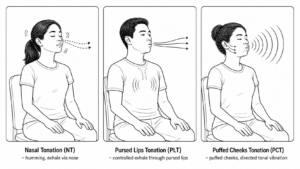 Pursed Lips Tonation: Participants exhale in a controlled fashion with Tonation through minimally opened lips. One has to ensure that one puffs the cheeks (like when someone plays the bamboo flute). The multiple benefits it offers include improved respiratory health by enhancing oxygen intake, managing shortness of breath, aiding in the reduction of anxiety, panic, stress, and related concerns.
Puffed Cheeks Tonation (PCT): While Pursed Lips Tonation is a Musopathy adaptation of an existing breathing technique by the same name, there is no particular breathing technique employing Puffed Cheeks. In medical practice, puffed cheek technique is a diagnostic maneuver used during CT Scans to distend oral tissues for better visualization of mouth lesions. However, PCT is an important Musopathy technique which can be applied to provide relief from issues in the Trigeminal area including face, jaw and dental pain. In PCT, participants puff their cheeks and exhale with controlled force while also vocalising a single frequency. One can also puff one side of the cheeks or puff sides partially depending on the area of the ache. For instance if the right side of the neck is strained, puffing the cheeks to direct the air flow and tonal vibration may help. Alterations to these as well as head and face positions (towards the area of pain) can be made based on common sense and body awareness.
Buzz Tonation
Buzz Tonation is an adaptation and simplification of the finger positions used in Bhramari Pranayama, retaining its basic principles while making it accessible to individuals unfamiliar with yoga. While its basic principle is centred on participants exhaling through partially closed nostrils with a bee‑like vibrating sound, finger placements of both hands as well as the ideal tonal texture of it must be learnt directly from qualified Musopathists. They must focus on varying experiences when both ears are closed fully or partially.
Benefits: Buzz Tonation proved to be particularly handy during the COVID 19 pandemic, improving not only the overall respiratory health of hundreds impacted by the virus but also providing many of them relief from sinus headaches. Given that several studies testify to up to 15‑fold enhanced nitric oxide production, it has high potential to support memory and muscle health. It also increases internal vibration within the body and can potentially accelerate relief from neck or facial muscle strain.
Pronal Tonation
Pronal Tonation is a significant yet non‑strenuous method to improve oxygen saturation. Participants lie in a prone position with pillows or cusions placed under the head, chest, and legs, and then produce Tonation through the nostrils at any comfortable frequency. During the COVID‑19 pandemic, several participants reported increases of about 6–12 points in SPO2 levels and, in some cases, were able to avoid hospital visits by regularly practising Pronal Tonation. The exact posture, cushion placements etc need to only be learnt from experts for optimal oxygen saturation.
Geometric Tonation
Geometric Tonation is primarily an anxiety‑reducing method that also enhances respiratory function. It parallels “box breathing” techniques used worldwide but incorporates Tonation. The practice has four phases – inhalation, breath-holding, exhalation with Tonation, and a pause before the next inhalation – each maintained for at least four seconds, forming a “Square Tonation” pattern. Musopathists have also introduced variants such as “Rectangular Tonation” (longer inhalation and Tonation phases) and “Triangular Tonation,” in which the final pause is omitted.
Table Summarising these and a few other TBTs
Subtle Positional Adjustments: One can also puff one side of the cheeks partially to focus the Tonation from different parts of the throat, face and mouth and assess the impact of diverse positions on strained voices or facial muscles. One can also alternate between Nasal and Pursed Lips Tonation or choose one over the other based on which seems to be the most relaxing.