Musopathy Tonation Breathing Techniques (TBT) consist of a set of specially developed breathing exercises consisting of organic, non-strenuous inhalation and controlled exhalation with Melodic Tonation. Tonation is self-produced sustained single musical frequency (like 440 Hz) that is comfortable to the participant at the given time, usually through the nose or pursed lips.
Origin of TBT
TBTs were introduced during the Covid pandemic when over 580 million people faced acute respiratory distress. Several breathing exercises propounded by experts – though very beneficial in diverse ways – proved to be too demanding for patients tremendously weakened by the havoc the Coronavirus created. TBTs were developed to not only address this problem with an additional layer of musical Tonation which contributed significantly as a self-soothing agent besides effortlessly improving their lung function and bestowing numerous other benefits. TBT has since shown a significant potential to promote fundamental Health and Wellbeing in many ways both clinically and psychologically, multiple videos here illustrate. 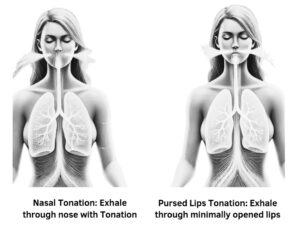
Preliminary observations and Pilot Studies have shown that TBT helps increase HRV, helps manage or resolve respiratory issues (which proved particularly useful to hundreds during the Covid pandemic), increase SpO2, hypertension, high sugar, pain, muscle strain, stress, anger, anxiety, sleep disorders etc and helps improve focus, calmness and attentiveness.
TBT can be viewed as Meditation in Music as it taps on primordial Cosmic Vibrational principles but it is far more than that. In fact they are more focused on breathing than on making music and have elements of mindfulness, meditation and Yoga embedded as well, potentially offering benefits derived from the practice of all these.
TBT = Tonation + Elements of (Meditation + Breathing Exercises + Music + Mindfulness + Yoga)
Though TBT does not requires any knowledge of other practices from patients, it can be practiced along with any other physical or mental training program.
How TBT Combines Various Elements
Challenges of Various Practices and TBT
Each of these practices offer several benefits but also have innate challenges that practitioners have to overcome. For instance, Music, Meditation and Yoga require a high level of mental and physical fitness and control. TBT on the other hand is probably the least demanding technique, making it highly accessible to even a 4 or 5 year old or a patient with severe illness.
This does not automatically translate to TBT being better than the above practices. In reality, various people may prefer one of these methods over the others, based on their natural inclinations and comfort zones.
Practicing TBT
The Key
Mindfulness is the key to approaching TBT (as well as life). One must try and focus on how the affected part of one’s body is responding to the vibrations. In the case of practising TBT for mental calmness, increased focus and enhanced awareness, one needs to let go of conscious thought processes and focus on the purest tonality one can generate.
Fundamental TBTs
Modern mainstream voice analysts talk about two types of Voice based on body parts which are engaged: Chest Voice & Head Voice. However, Indian scholars have done a deeper dive into the subject and spoken about five principal areas engaged in musical tonal production: Navel, Chest, Throat, Tongue and Nose. Similarly, while Tonations can be broadly classified as Chest Tonation and Head Tonation, Nasal, Diaphragmatic and other Tonations are no less important.
Chest and Head Tonation
Chest voice is generally in much lower pitches and heavier in texture. It is used by most people during normal speech. Similarly, Chest Tonation will be in lower pitches and participants will feel vibrations in the chest and throat because the vocal folds are thicker and fully engaged, giving a richer, heavier sound. Head voice uses high pitch frequencies and the texture will be sharper (with more treble) and it will be lighter in terms of “note or word weight”. It will resonate more in the head and facial area because the vocal folds stretch and thin out, vibrating faster enabling vocalists to sing higher notes with less strain, while still maintaining a quality tonality. Similarly, Head Tonation will involve high pitch frequencies.
While good music training involves mastering both chest and head voice and at times blending the two to get a wholesome texture, Musopathy focuses more on the various areas of the body that can be benefited through Chest or Head Tonation.
Diverse TBTs
There are several types of TBT such as Buzz Tonation, Diaphragmatic Tonation and Pronal Tonation but most are adaptations of the the basic types, Nasal. Pursed Lips and Puffed Cheeks Tonations.
Nasal Tonation: Participants exhale in a controlled manner with Tonation through the nose with mouth completely closed. They can observe how their entire body relaxes as they give this Tonation and also how the mind also gradually feels calmer. This technique offers numerous benefits, from relieving nasal congestion during a common cold to enhancing lung function during or after COVID-19 recovery. Additional advantages include reducing stress, anxiety, fatigue, muscle tension, and sinus headaches, as well as aiding in depression management. It also promotes increased energy, stamina, focus, clarity, decision-making abilities, and leadership skills.
Pursed Lips Tonation: Participants exhale in a controlled fashion with Tonation through minimally opened lips. One has to ensure that one puffs the cheeks (like when someone plays the bamboo flute). The multiple benefits it offers include improved respiratory health by enhancing oxygen intake, managing shortness of breath, aiding in the reduction of anxiety, panic, stress, and related concerns.
Puffed Cheeks Tonation (PCT): While Pursed Lips Tonation is a Musopathy adaptation of an existing breathing technique by the same name, there is no particular breathing technique employing Puffed Cheeks. In medical practice, puffed cheek technique is a diagnostic maneuver used during CT Scans to distend oral tissues for better visualization of mouth lesions. However, PCT is an important Musopathy technique which can be applied to provide relief from issues in the Trigeminal area including face, jaw and dental pain. In PCT, participants puff their cheeks and exhale with controlled force while also vocalising a single frequency. One can also puff one side of the cheeks or puff sides partially depending on the area of the ache. For instance if the right side of the neck is strained, puffing the cheeks to direct the air flow and tonal vibration may help. Alterations to these as well as head and face positions (towards the area of pain) can be made based on common sense and body awareness.
Subtle Positional Adjustments: One can also puff one side of the cheeks partially to focus the Tonation from different parts of the throat, face and mouth and assess the impact of diverse positions on strained voices or facial muscles. One can also alternate between Nasal and Pursed Lips Tonation or choose one over the other based on which seems to be the most relaxing.
General Advantages of TBT
There are several broad benefits of TBT and a few are listed below.